Average 5× higher yield
more biomass per run (yield depends on organoid type)

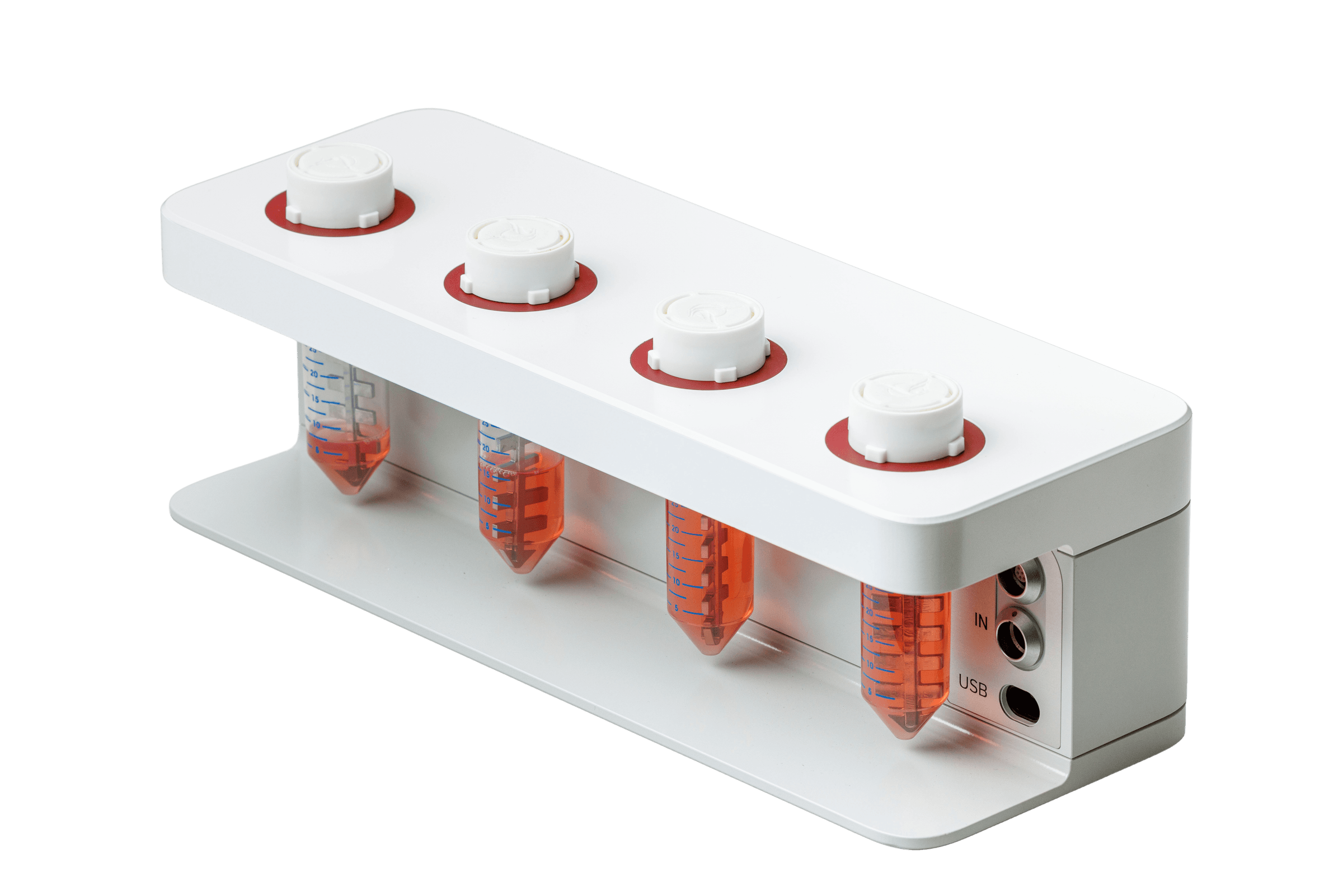
Orgonex develops advanced technology to accelerate, scale and standardize organoid culture. The RPMotion bioreactor creates a dynamic micro-environment that increases organoid yield and quality while reducing culture costs, without changing your existing workflow.
more biomass per run (yield depends on organoid type)
automation instead of tedious manual handling steps
the bioreactor design reduces the total media volume needed
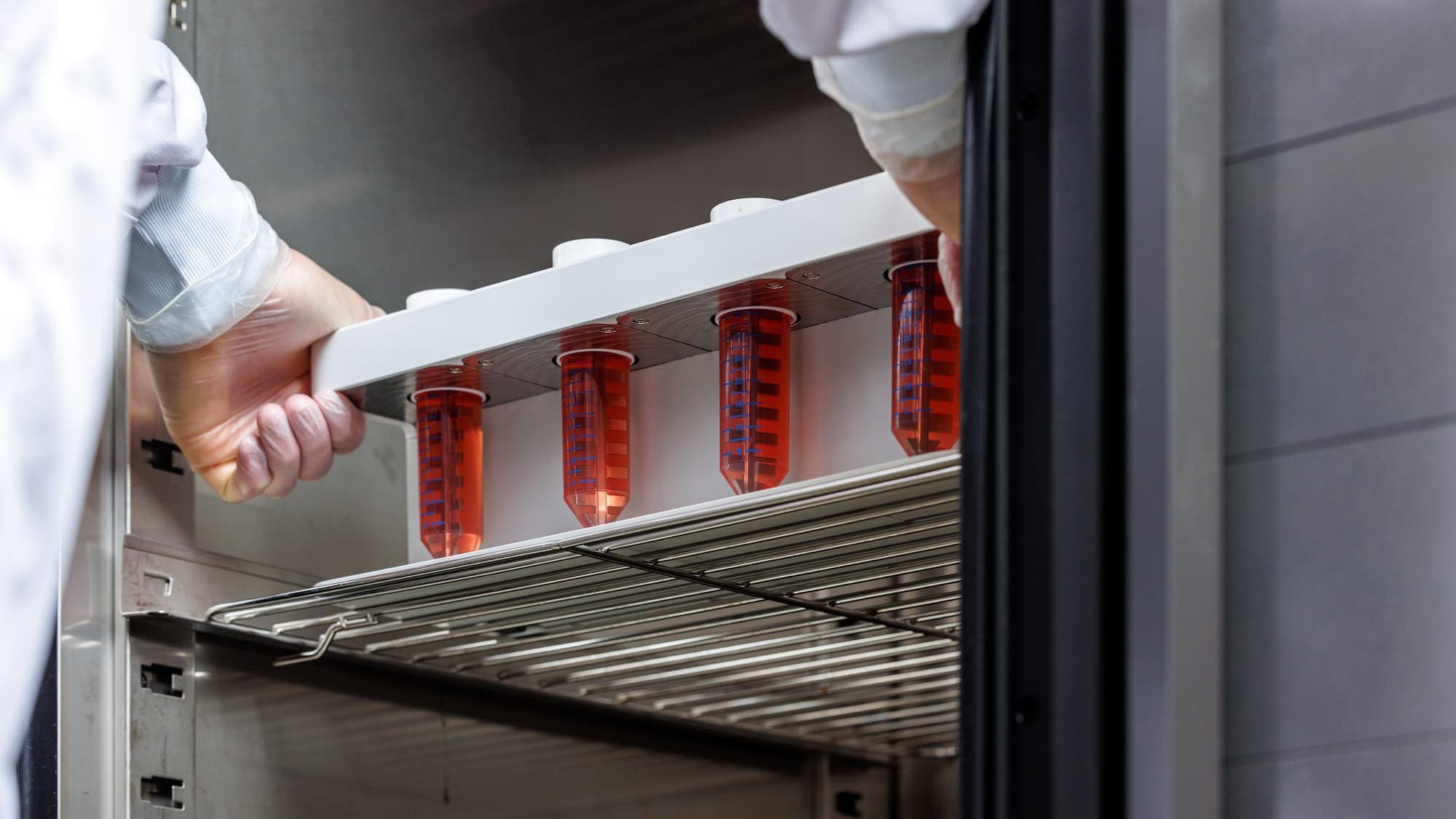
The RPMotion is a spinning organoid bioreactor that seamlessly integrates with your laboratory infrastructure. A dynamic culture system that keeps organoids continuously in motion, resulting in a more homogeneous distribution of nutrients, oxygen and growth factors compared to static dome cultures. It consists of patented stirring rods in standard 50 mL conical tubes, fits inside your existing CO₂ incubator, and supports up to 32 parallel runs per incubator. The result is a significantly higher organoid yield with biological relevance retained.
It's used by research teams in academia, biopharma and biotech working with organoids, from expansion and biobanking to drug screening and infection models.
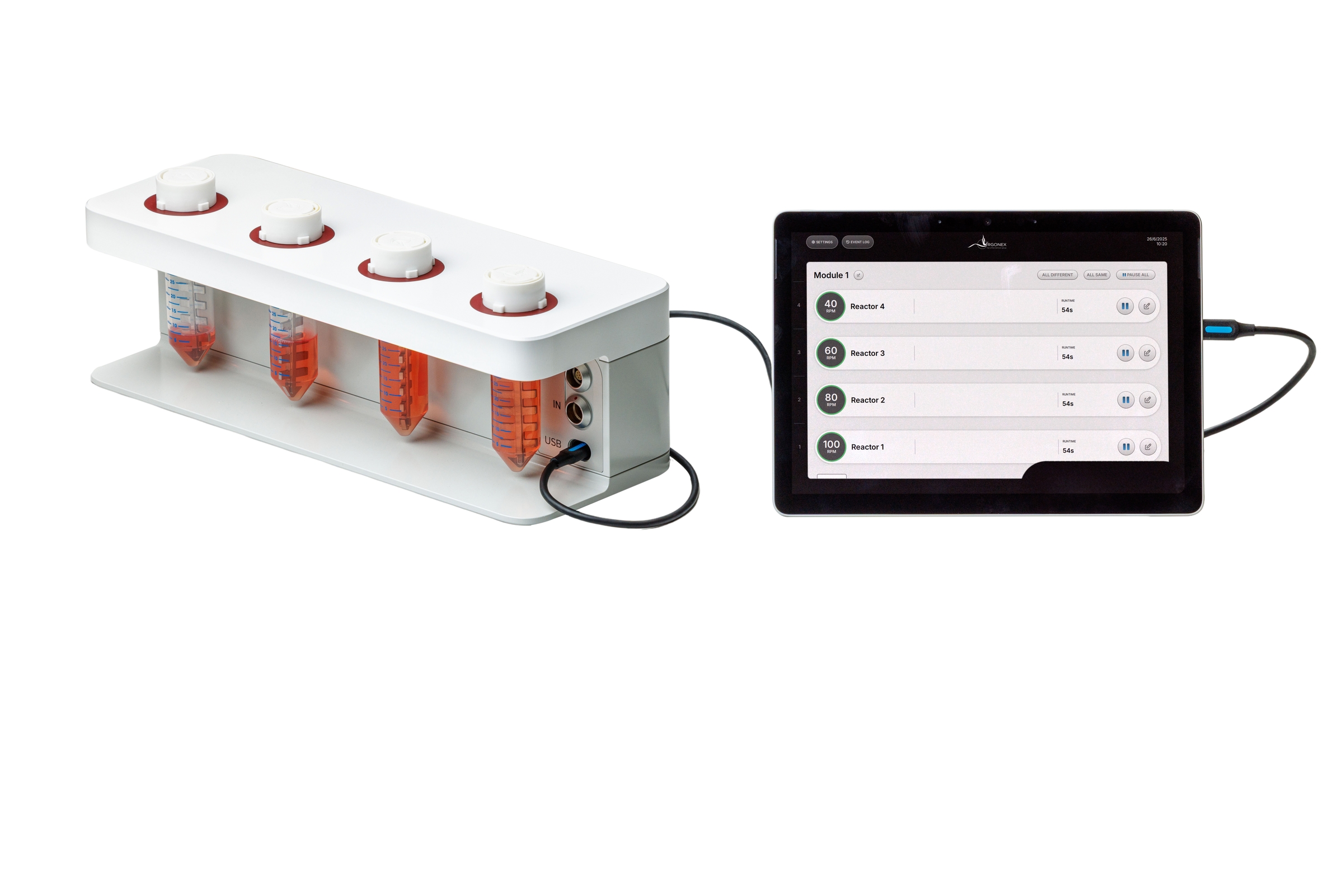
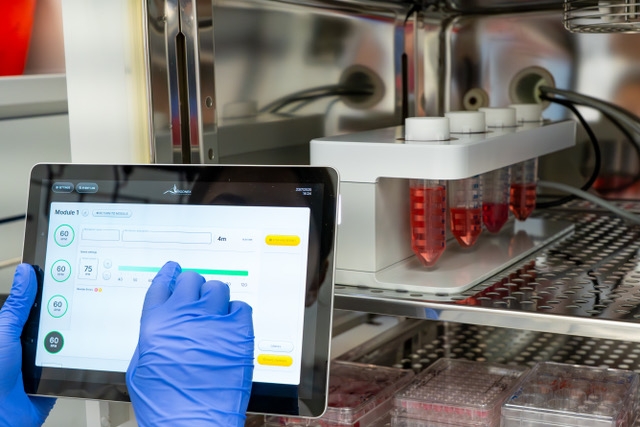
Place the bioreactor in your cell-culture incubator and connect it to the external control unit.
Patented stirring rods, designed specifically for gentle organoid suspension culture, homogeneously resuspend your cells, media, extracellular matrix and growth factors and improve oxygenation. Creating ideal conditions for organoid expansion or differentiation.
An average 5-fold higher organoid yield, with consistent organoid quality from run to run.
Continuous, gentle motion ensures homogeneous gas and nutrient exchange across the whole suspension culture, while in a static hydrogel dome, cells in the centre may starve or suffocate. You also have the option to refresh media during culture by briefly settling the organoids between runs, something that isn't possible in a fixed hydrogel dome.
In a static dome culture, organoids depend on diffusion of nutrients and oxygen, while waste builds up locally. As a result, organoids at the edge of the hydrogel dome are exposed to different conditions than those in the centre. In contrast, the RPMotion's continuous, gentle motion keeps conditions even across the whole culture.
The result for your data: more biomass per run and more uniform culture conditions, without changing the functionality of your organoids.
✔ Reduced operator-dependent variability - Greater automation and a streamlined, standardized workflow make results less dependent on individual operator experience and handling.
✔ Efficiency - Higher throughput, far less manual handling, fewer failed cultures.
✔ Biological relevance - A dynamic micro-environment is more physiological than a static dome culture.
✔ Scientific support - Standard Operating Protocols and hands-on guidance from the Orgonex team, especially helpful when starting on a new organoid type.
✔ Workflow fit - The RPMotion drops into existing workflows with minimal training; experiments can be started within one day.
— Biomaterials Chemistry Group, Dutch University
Specification | Value |
|---|---|
| Culture principle | Stirred suspension with patented stirring rods optimized for organoid culture |
| Organoid source | Organoids derived from adult stem cells and iPSCs |
| Validated breadth | Proven increased expansion for organoids from a wide variety of tissues — healthy and tumor-derived |
| Working volume | 5 mL starting volume per tube; up to 50 mL filled volume after two weeks |
| Vessel format | Standard 50 mL conical tubes (e.g. Falcon, Greiner) |
| Cell load (typical) | Inoculate ~100,000 cells/mL in 5 mL; adjust to growth rate. Yield after two weeks: 20–40 million cells per tube |
| Throughput | Up to 32 tubes per incubator (modules of 4 tubes) |
| RPM range | 40–100 rpm; optimum around 80 rpm for most organoid types |
| Control | External LCD control unit, placed outside the incubator, logs your experiments |
| Compatibility | Standard CO₂ incubators; works with Matrigel, BME2 or matrix-free suspension |
| Disposables | Stainless-steel stirring rods are autoclavable and reusable; caps with integrated filter are disposable, available from Orgonex |
Your optimized organoid culture protocols translate directly to suspension culture in the RPMotion, using the same media and ECM components. If you grow in Matrigel or BME2, you keep doing so inside the bioreactor. We recommend 5 - 10% (v/v). If you grow matrix-free in suspension, no matrix is needed in the RPMotion either.
How dynamic culture in the RPMotion stacks up against the methods most labs use today: across mixing, working volume, vessel, throughput, uniformity and hands-on time.
RPMotion | Static dome | Spinner flask | Orbital shaker | |
|---|---|---|---|---|
| Mixing | Organoid-specific stirring rod (gentle, dynamic) | None (static hydrogel) | Impeller-driven | Orbital agitation |
| Working volume | 5–50 mL | µL–mL droplets | 100 mL + | Variable |
| Vessel | Standard 50 mL conical tube | Multiwell plate / dish | Proprietary flask | Flask / plate |
| Throughput per incubator | Up to 32 (8 modules) | Plate-limited | Low (bulky) | Plate-limited |
| Uniformity | No heterogeneity from diffusion limits | Edge vs. core differences | No heterogeneity from diffusion limits | Variable |
| Hands-on labour | Up to 75% reduction | High | Moderate | Moderate |
The RPMotion works across a broad range of organoid types. Below are the ones we have validated so far. Both cystic and compact/budding organoids grow well, and budding phenotypes are retained inside the RPMotion.
For example liver, small intestine, pancreas, kidney, and colon.

For example colon, breast, lung, and paediatric tumours.
For example cardiac, brain, and liver.
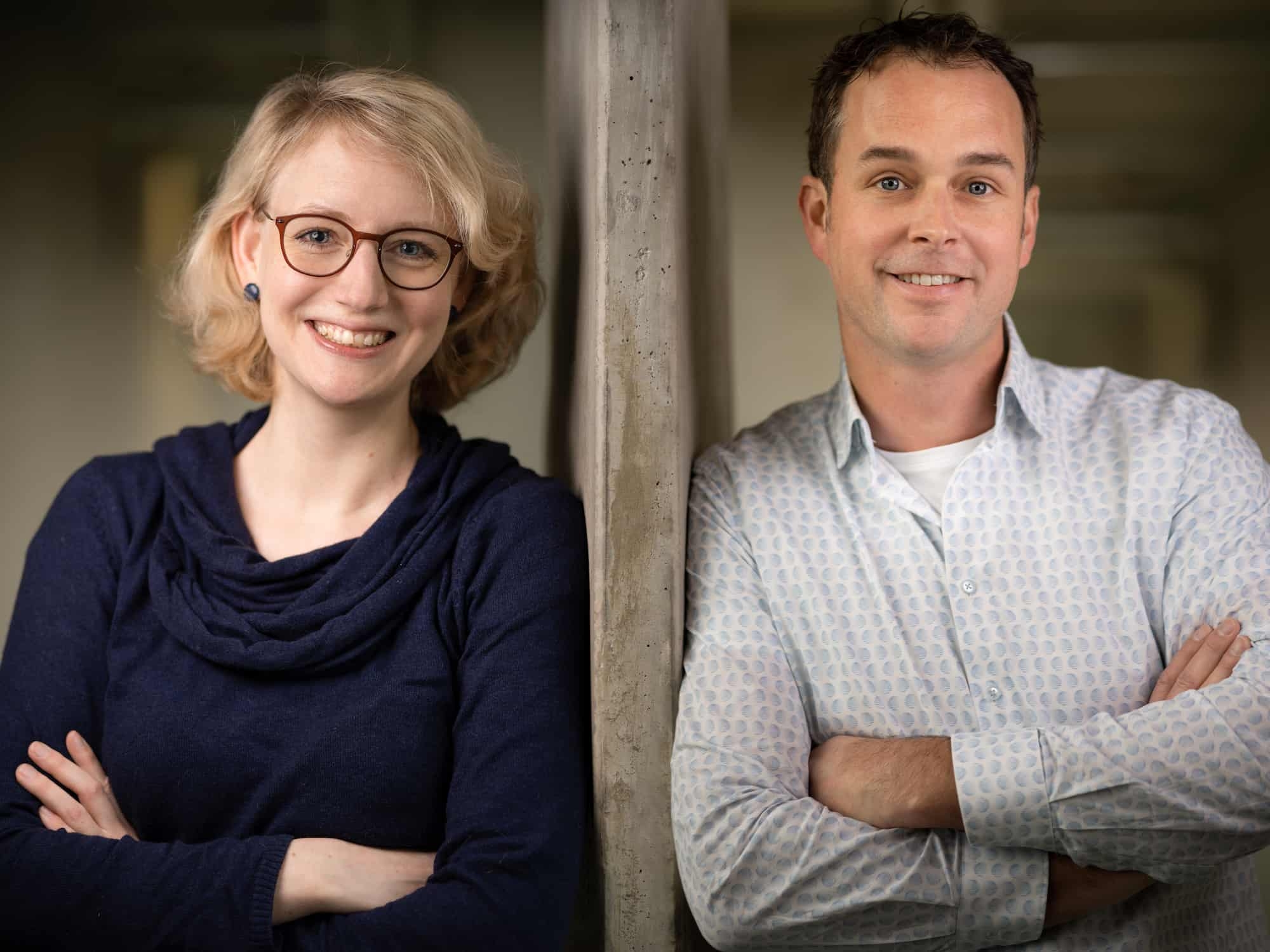
The RPMotion was developed by Dr. Kerstin Schneeberger and Dr. Bart Spee at Utrecht University, organoid scientists who built it to solve the variability and labour problems they kept running into during their own experiments. Their work has been published in the peer-reviewed journal Cell Reports Methods. Orgonex, a spin-off company of Utrecht University, and now part of the Demcon group, has further developed the RPMotion under an exclusive license.





RPMotion is a spinning organoid bioreactor — a dynamic culture system that keeps organoids continuously in motion, distributing nutrients, oxygen and growth factors more homogeneously compared to static dome cultures. The result is a higher organoid yield with retained functional relevance.
RPMotion is plug-and-play. Minimal adaptation is required. The RPMotion uses the same media and ECM components as your current protocol; the main difference is that organoids grow in suspension rather than in a static hydrogel dome.
Yes. It fits in standard CO₂ incubators and uses standard 50 mL conical tubes, so integration is simple. The only RPMotion-specific item is the filter cap, which is available from Orgonex.
Yes. Both cystic and compact organoids grow well in the RPMotion, and organoids that show a budding phenotype in static culture retain that phenotype inside the bioreactor.
If you currently grow your organoids in an ECM matrix (Matrigel/BME2), you use the same in the RPMotion, we recommend 5 - 10% (v/v). If your organoids grow matrix-free in suspension, none is needed in the RPMotion either.
Optimal speed varies slightly by organoid type, between 40 and 100 rpm. We recommend optimizing for new organoid types, or starting at 80 rpm, which works well for most organoid types tested.
It depends on the organoid type. As a guideline, inoculate ~100,000 cells/mL in a 5 mL starting volume. Faster-growing organoids usually proliferate better at lower starting concentrations; for organoids that proliferate better at higher density in static culture due to dependence on paracrine signaling, we recommend starting the RPMotion with a higher inoculation density.
All three. You can inoculate the RPMotion from existing static cultures, directly from organoids stored in liquid nitrogen, or — as shown in the supplementary data of our publication — directly from a biopsy.
Yes to both. After two weeks the tube is full according to our SOP; simply passage an aliquot into a new tube to keep the culture going. To differentiate, let the organoids settle (or briefly spin at low speed), remove the expansion medium, and resuspend in differentiation medium.
The stainless-steel stirring rods are reusable after autoclaving. The caps with integrated filter are disposable and available from Orgonex, contact us for pricing details.
We offer a structured demo in which you can test culturing your own organoid type in the RPMotion, while we support you with advice throughout the experiment.